
February 8, 2026
Staff Writer
Most people don’t quit publishing because they lack ideas.
They quit because the publishing workflow they are struggling with has become exhausting.
Not dramatic exhaustion.
Not burnout with fireworks.
The quiet kind.
The kind that shows up when you sit down to work and realize you don’t know where anything lives, what version is current, or what step comes next. So you reorganize. Again. And call it “preparing to work.”
At some point, even motivated people start avoiding the thing they actually care about.
This isn’t a discipline problem.
It’s tempting to tell ourselves things like, I just need to focus more, or I should be more organized, or I’ll clean this up later. But if that were true, it would have worked by now.
What’s really happening is simpler.
Your brain is doing too much invisible work.
Every time you decide where a file should go, rename something for the third time, rebuild the same structure for a new project, or wonder if you’re forgetting something important, you’re spending cognitive energy that never shows up in the finished product.
That energy leak adds up.
Publishing workflow isn’t just about writing or creating. It’s drafts, revisions, exports, formats, metadata, assets, versions, backups, and the quiet promise that you’ll remember what something means later.
Most systems people use grow organically. That sounds good until you realize that “organic” usually means inconsistent. And inconsistency forces your brain to renegotiate the rules every time you start.
That’s the friction no one talks about.
The frustrating part is that the people most affected by this are often the most capable. They care about quality. They iterate. They improve. So their systems keep changing.
Eventually, every project starts to feel like rebuilding the wheel, setting up before you can begin, and cleaning before you can think.
At that point, the work stops feeling creative and starts feeling heavy. Not because the work is wrong, but because the container for the work is unstable.
There’s a misconception that structure kills creativity. In practice, the opposite is usually true.
Structure removes repeated decisions, background tension, and those what am I forgetting? moments. It creates a default path so your attention can stay on the thing that actually matters.
You don’t need a complex system.
You need a repeatable one.
One that doesn’t change every week.
One that doesn’t rely on memory.
One that doesn’t require motivation to function.
There’s a noticeable shift when you stop rebuilding your publishing process every time. You open a project and the folders already exist. The naming makes sense. The steps are clear. Nothing feels fragile.
That relief is subtle, but powerful.
It’s the difference between I should work on this and I can just work on this.
That’s where consistency actually comes from.
If this article resonates, it’s probably because you’ve felt that friction firsthand.
I built a simple Publishing Packet Generator as a way to remove that repeated setup work. Not to dictate how you create, but to give each project a stable container from the start.
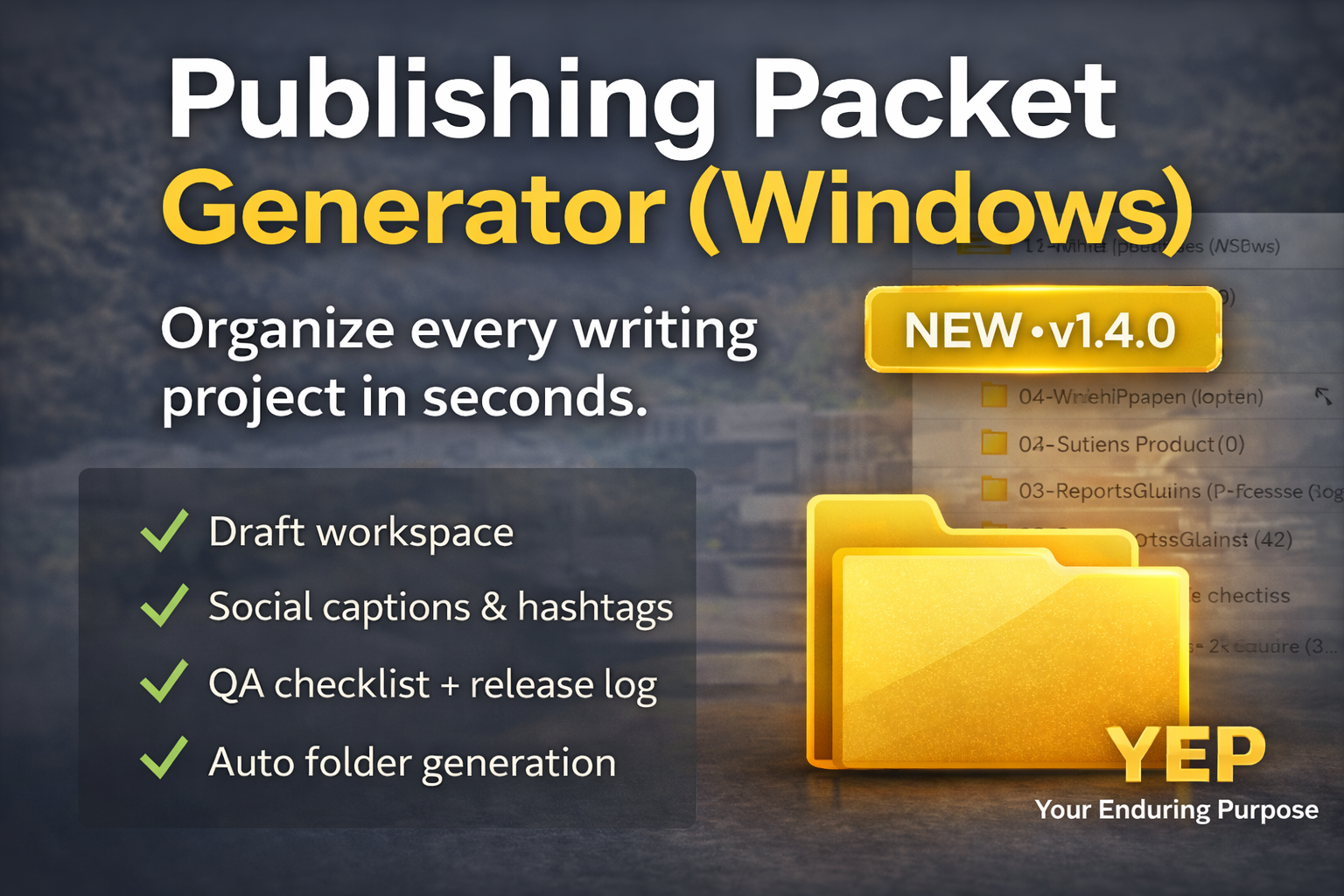 The Publishing Packet Generator
A simple way to remove repeated setup work and give each project a stable starting point.
It’s not a methodology or a promise of success.
It’s a way to stop paying the same cognitive tax over and over again.
If you want a practical way to apply this without rebuilding your workflow each time, the Publishing Packet Generator is available here.
Use it if it’s helpful. Ignore it if it’s not.
Either way, the principle stands.
When the structure holds, the work can breathe.
Share
Recent Posts

Building Your Own PC: The Psychology Behind Skill, Confidence, and Control
February 19, 2026
Building Capability in a World Designed for Consumption I began building computers as a young teenager, partly because at that time it was...

Can Technology Keep Accelerating Forever?
February 12, 2026
Those who entered technology recently often experience it as a constant surge. New tools appear overnight. Entire workflows become obsolete in a year....

Social Media: How Over-Exposure Becomes Moral Erosion and Societal Decline
February 12, 2026
There was a time when social media platforms carried an unspoken understanding of boundaries. Not perfection, and certainly not uniform agreement, but a...