
December 26, 2025
Staff Writer
A Long-Form Reflection on Meaning After Loss
Derek Wood
Loss, often loved ones, changes the function of meaning, in the life of individuals.
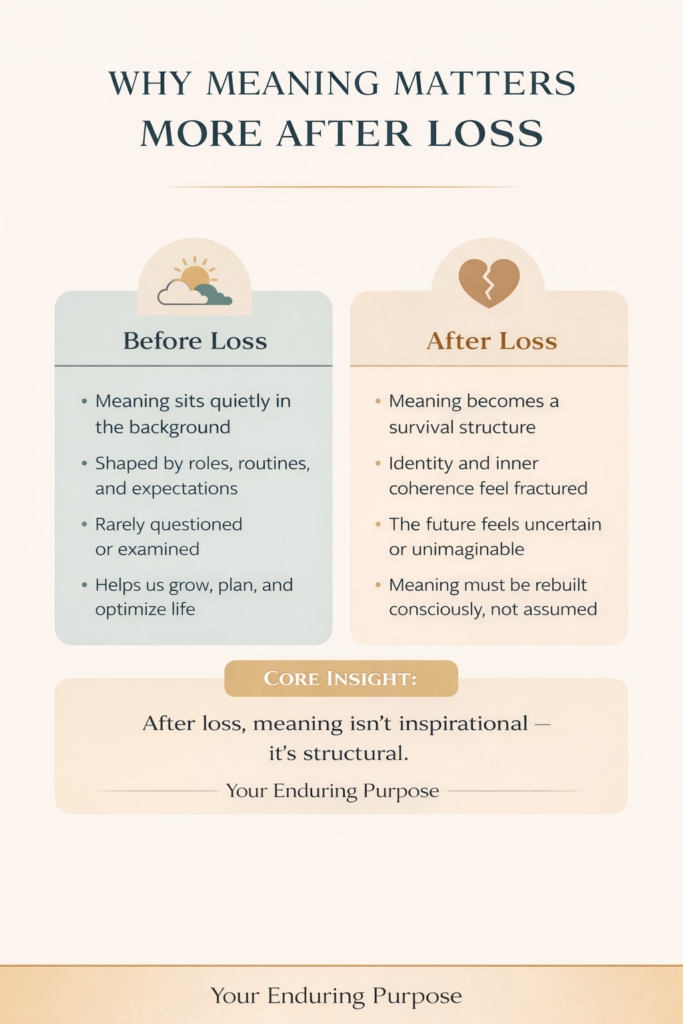
Before encountering sufficiently difficult loss, such as a loved one, or even a lifelong job, one’s predisposition to “meaning” often operates quietly in the background of life. It is a hidden sensations embedded in routines, roles, relationships, beliefs, and future expectations. Most people do not consciously give thought or construct a sense of meaning before such disruption because they simply do not need to. Life often feels comfortable and intelligible enough to move forward as it always does.
After catastrophic loss, this changes.
Loss does not simply introduce the recipient to pain or sadness. It fundamentally fractures the internal systems that once made life that person’s life coherent. It disrupts an individual’s identity, their internal narrative continuity, and even alters future orientation. What once felt self-evident, why you get up in the morning, who you are in relation to others, what tomorrow is for, can suddenly feel inaccessible or false.
This is why meaning matters more after such a loss than before it.
Not because it becomes more inspiring, but because it becomes more structural.
Meaning Before Loss Is Often Assumed
Before loss, meaning is usually inherited or borrowed. It comes from roles, expectations, and continuity rather than deliberate reflection. Career progression, family identity, faith participation, and long-term plans quietly organize life. Meaning is present, but largely unexamined.
This does not make pre-loss meaning invalid. It makes it untested.
As long as life feels cooperative, meaning can remain implicit. Even hardship tends to feel temporary or instructive. The future remains imaginable. Effort still seems worthwhile.
Meaning, in this phase, supports growth and optimization.
Loss Is a Meaning-Destroying Event
What makes a deep loss uniquely destabilizing is not just emotion alone. It is the collapse of the individual’s coherence.
Trauma research consistently shows that humans can endure immense pain if they understand why it is happening or what it is for. What people struggle to survive is senselessness. Loss does not only remove something valuable, it invalidates the frameworks that once explained why effort, attachment, and hope even made sense in the first place.
This is why advice, reassurance, or even compassion often fall flat after personal loss. They only address a finite range of human emotion while leaving deeper resonant meaning to collapse potentially ignored, and ultimately untouched, and unhealed.
Disorientation after such a major loss is not weakness. It is evidence that something foundational has broken.
The Meaning Inversion Principle
Here is the central shift loss creates:
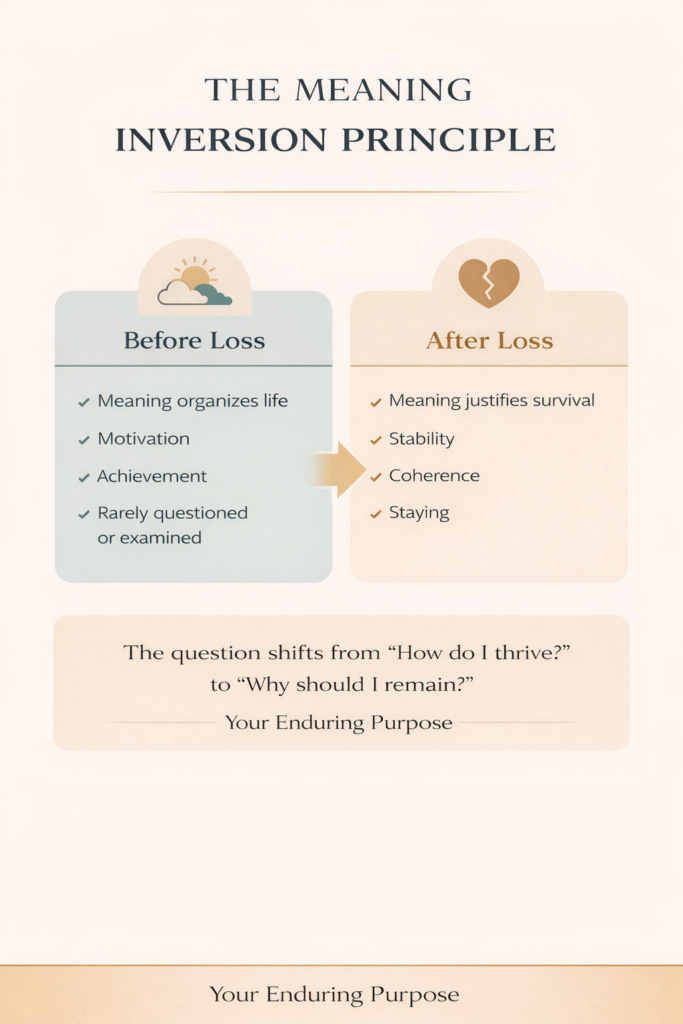
Before loss, meaning organizes life.
After loss, meaning justifies survival.
This is what I will call the Meaning Inversion Principle.
Before loss, meaning enhances life. It motivates, directs, and supports fulfillment. After loss, meaning becomes anchoring rather than aspirational. Its primary function is no longer growth, but stabilization.
This is why motivational language often fails people after loss. Inspiration assumes that life already feels worth continuing. After loss, that assumption can no longer be taken for granted.
The question changes from “How do I thrive?” to “Why should I remain?”
That question is rarely spoken aloud, but it is often present beneath the surface of post-loss life.
Why Loss Forces Conscious Meaning-Making
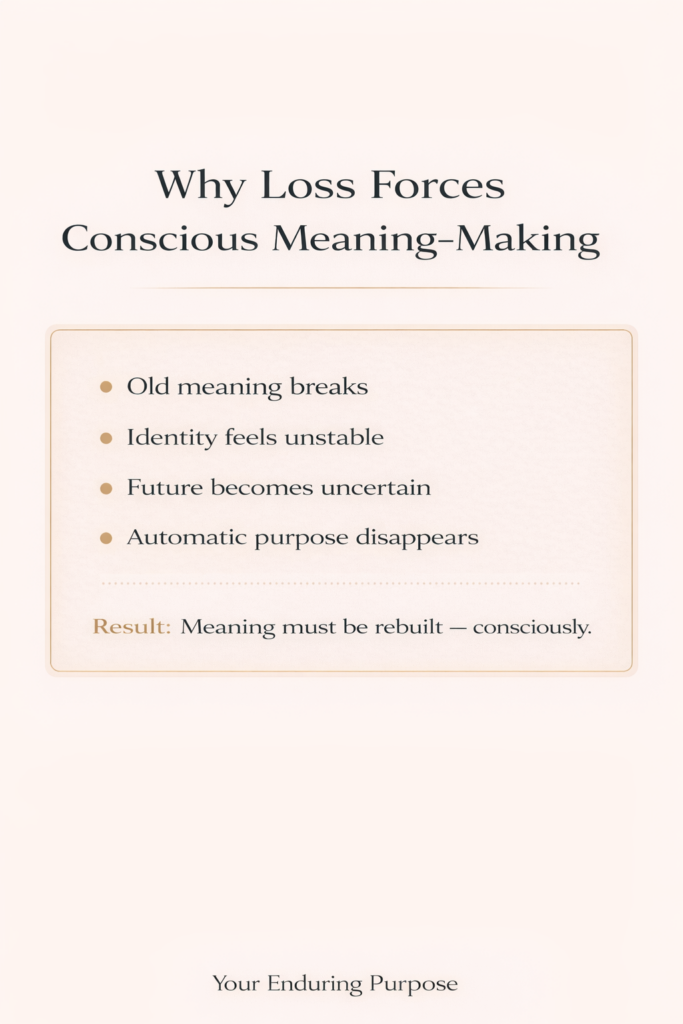
After loss, your life’s meaning can no longer remain ambient. The conditions that sustained it, such as continuity, predictability, and trust, have been disrupted or removed entirely. Without the conscious reconstruction of personal meaning, people are left trying to live inside broken frameworks that no longer fit their lived reality.
This is why platitudes and quick reassurance often feel hollow. They attempt to restore comfort without restoring coherence. This causes a mismatch to the core psyche of the individual experiencing the loss.
Conscious meaning-making after loss is not only a simple act of optimism. It becomes a necessary response to structural collapse. Avoiding this internal work does not protect people; it leaves them suspended in unresolved disorientation, vulnerable to withdrawal, numbing, or despair. This is not because they lack resilience, but because meaning itself has not yet been rebuilt.
Faith After Loss Is Tested, Not Proven
Loss is not only a psychological crisis. It is often a theological one.
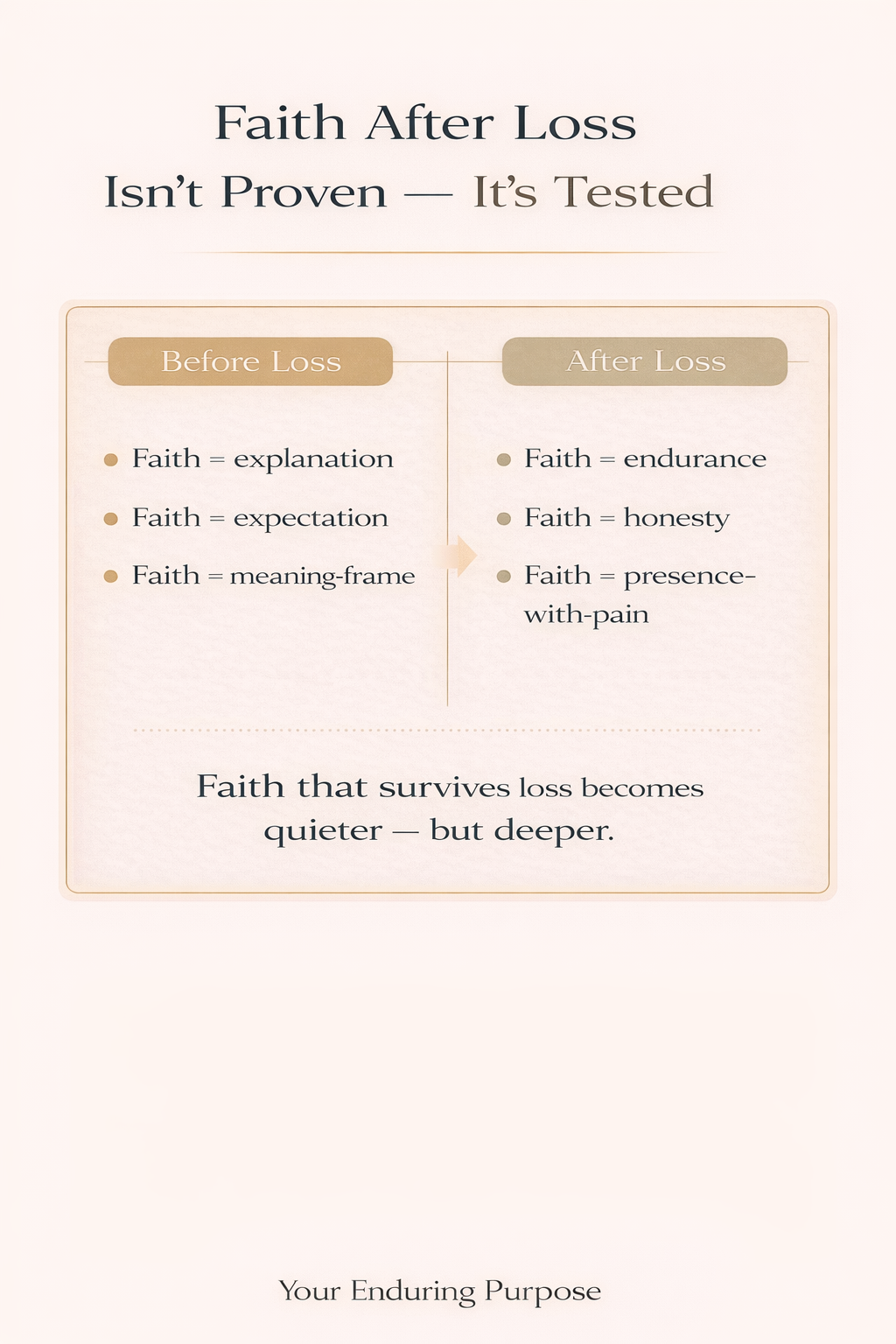
Loss exposes whether a person’s faith functions as a source of endurance or merely as an explanatory system dependent on favorable outcomes. When faith is forced to coexist with unanswered questions and unresolved pain, it either fractures or matures.
Faith that survives loss is quieter and heavier. It carries less certainty and more honesty. It does not promise protection from suffering. It offers companionship within it. This may feel contradictory to most.
This kind of faith is not about resolution. It is about remaining present without denial.
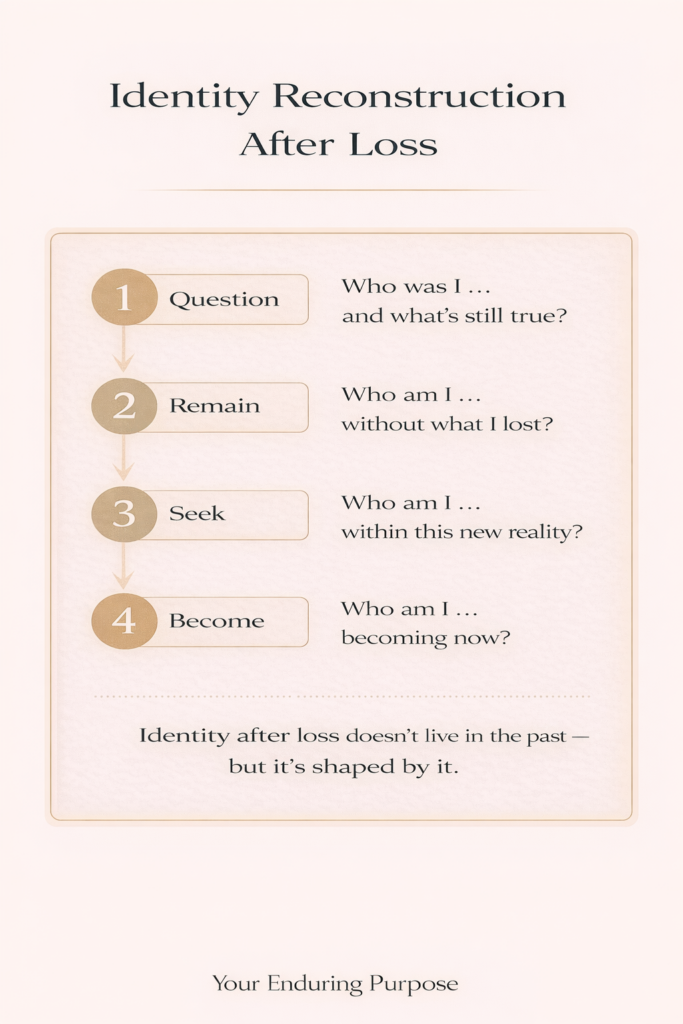
Identity Must Be Reconstructed, Not Recovered
Loss forces an internal identity reckoning.
Many people try to “return to normal” after loss. This is understandable and often harmful. What was once “Normal” belonged to a internally constructed self that no longer exists. Post-loss identity is not a recovery of the past identity, but the emergence of a new self, image, shaped by limitation, memory, and altered capacity.
Accepting this does not mean surrender. It allows endurance itself to become a form of integrity rather than defeat. Staying becomes meaningful, not because life feels good again, but because presence is no longer arbitrary.
Meaning After Loss Is Smaller, yet Stronger
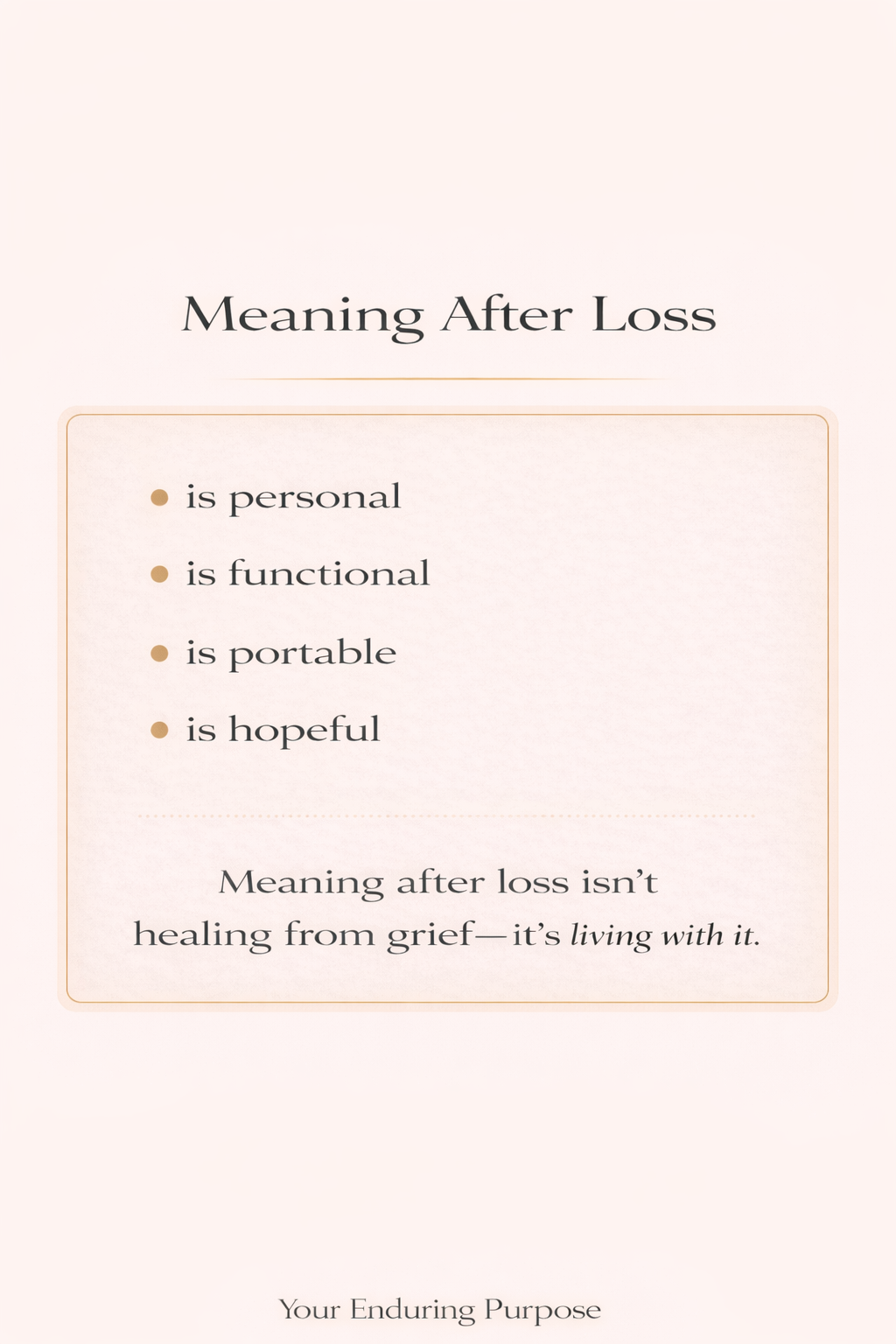
Meaning after loss rarely arrives as insight or revelation. Most will not wake up randomly one day and reaelize the change. More often, it emerges slowly through what a person continues to carry, tend, or protect despite diminished certainty.
It does not resolve grief. Even though we wish it did. Instead, It gives grief a place to live without consuming everything else.
After loss, meaning does not promise happiness. It promises that staying is not pointless. For many people navigating the “after,” that is not a small thing.
About Your Enduring Purpose
Your Enduring Purpose exists to remind people that growth, healing, and resilience are possible at every stage of life. Through reflective writing, storytelling, and practical tools for personal development, we help readers reconnect with meaning, faith, curiosity, and hope. This platform is built for real people doing real life — one honest step at a time.
Share
Recent Posts

Camp Daily Wins Character Profile – Gunter Pig
March 26, 2026
Home → Camp Daily Wins → Gunter Pig → Profile When your child struggles to believe in themselves, Gunter Pig helps them see...
Camp Daily Wins Character Profile – Stu Donkey
March 26, 2026
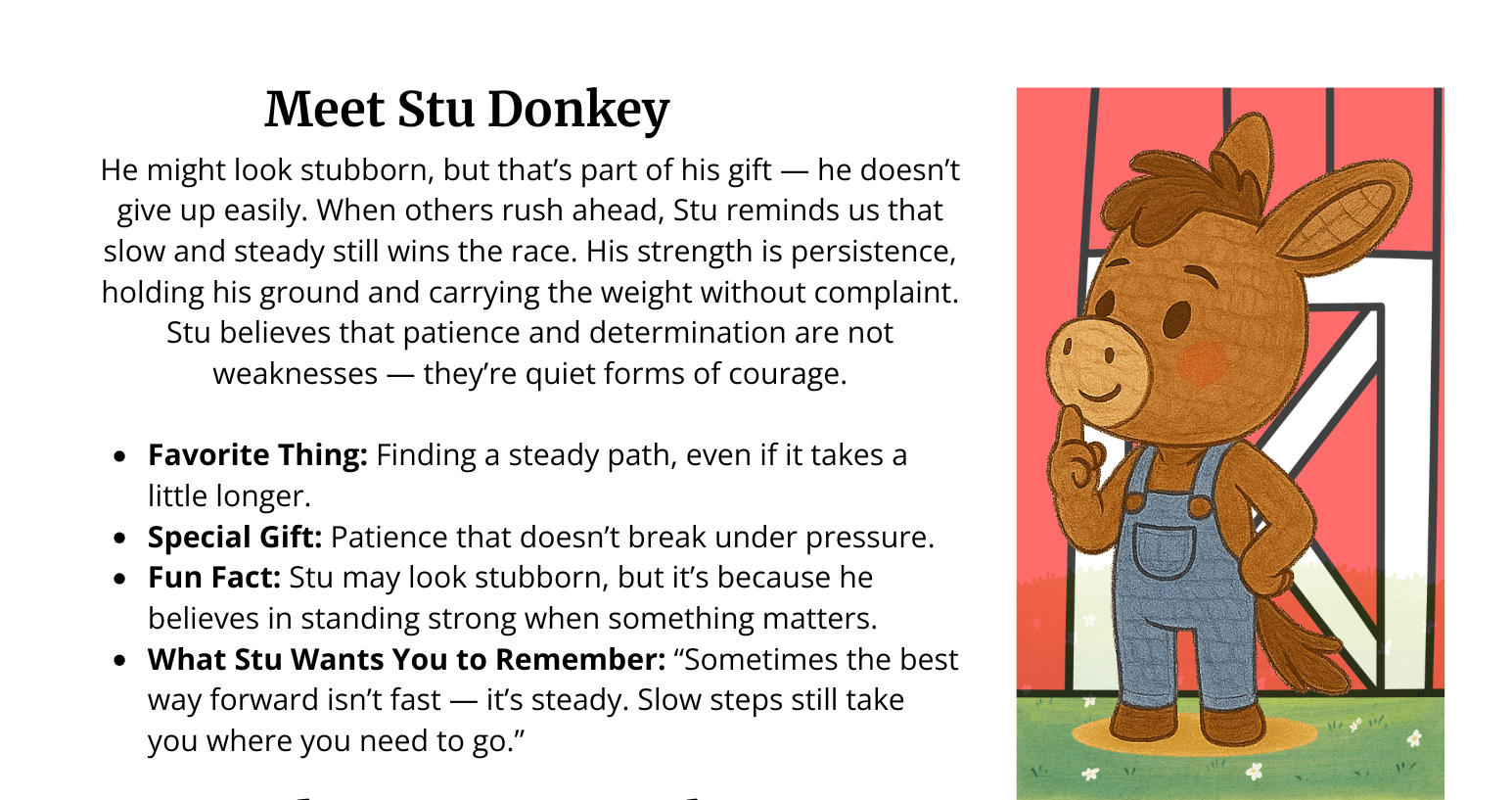
Home → Camp Daily Wins → Stu Donkey → Profile When your child wants to give up, Stu Donkey helps them learn how...

The Journey Doesn’t End When the Pages Do
March 24, 2026
Home → Camp Daily Wins → What Happens Nest? → Journey Doesn’t End Camp Daily Wins isn’t about finishing a journal. It’s about...